No Results Found
The page you requested could not be found. Try refining your search, or use the navigation above to locate the post.

The page you requested could not be found. Try refining your search, or use the navigation above to locate the post.

What’s up, traveler? If you’ve made it this far, let me introduce myself. I’m Sergio . I’ve been living in this wonderful corner of the Costa del Sol for exactly 40 years . I arrived here four decades ago, fell in love with the light, the people, and the smell of the sea, and decided to put down roots. Today, besides being a local who knows every pothole, every shortcut, and every beach bar, I own a local car rental business in Benalmádena .

So you can imagine: if there’s anyone who knows how to explore this town from top to bottom, how to navigate its three main areas without getting lost with a map, and where the real treasures are hidden without falling into the typical tourist traps, it’s me. Every day I’m constantly recommending itineraries to clients who have just landed and are requesting car rental services at Malaga Airport , and I always tell them the same thing: “Benalmádena isn’t just a beautiful beach. It’s three worlds contained within a single municipality . “
Get comfortable, because I’ve prepared a super comprehensive guide to Benalmádena, the kind you won’t find in regular travel agencies. I’m going to tell you everything from my perspective, with the honesty of someone who’s lived here half their life, based on the real-life experience of walking these streets day after day. From the majestic and unique Colomares Castle to the most magical corners of Paloma Park, including the food, accommodations, beaches, the fair, and its hidden history. Let’s get started!
Before you start the engine or slip on your flip-flops, the first thing you need to understand is the geography of this blessed place. Benalmádena covers an area of approximately 27 km² and boasts no less than 2,900 hours of sunshine per year , with an average annual temperature that allows you to experience a perpetual spring. The best part is that we are strategically located between Torremolinos and Fuengirola, just a 15-minute drive from Málaga Airport. It’s the perfect base for exploring the entire province.
But what’s truly unique is that Benalmádena is clearly divided into three distinct areas or urban centers. Each one has its own soul, its own rhythm, and its own charm:
As a car rental owner, my first piece of friendly advice is straightforward: although there is public transport (buses and trains), having a vehicle gives you the absolute freedom to have a breakfast of a “pitufo” (a type of pastry) with coffee in a hidden square in Arroyo de la Miel, go up to eat a good dish from the mountains in Benalmádena Pueblo and end the afternoon watching the sunset in a secluded cove on the coast.

Many people think that Benalmádena was built in the 60s and 70s during the Costa del Sol tourism boom. What a mistake! As someone passionate about local history, I always enjoy telling travelers that this land has a fascinating and ancient past.
The Phoenicians and Romans passed through here, drawn by the rich fishing grounds of our coasts and the favorable climate. In fact, the Romans actively exploited fish-salting facilities in the Benalmádena Costa area. But the true origin of the town’s current name and appearance is, of course, owed to the Arabs.
During the Muslim era, the area came to be called Ibn al-Ma’adin , which literally means “Sons of the Mines” or “The Mine of the Ships ,” due to the iron and ochre mines that existed in the mountains of the municipality. They built an imposing fortress on the hilltop (what is now the town) and watchtowers along the coast to defend themselves against pirate raids.
In 1485, during the Reconquista, the Catholic Monarchs captured the town of Benalmádena. The sieges and battles were so fierce that the fortress was practically destroyed and the town was temporarily deserted. It wasn’t until years later that repopulation began and the center of Benalmádena Pueblo was rebuilt, maintaining its labyrinthine Muslim layout but adapting it to the new times.
Today, as you stroll through the white village or admire the watchtowers integrated into the modern landscape of hotels, remember that you are walking on centuries of history, a history of sailors, miners, and knights. For more official information about our heritage, I recommend visiting the tourism website: turismo.benalmadena.es .
A trip up to the village is a must. I usually go on Sunday mornings, when the mountain air is crisp and the scent of orange blossoms from the patios fills the streets. If you’re driving (ideal for climbing the hill from the coast), my professional advice is clear: don’t try to drive into the historic center. The streets are narrow, mostly pedestrianized, and the turns are tricky. The best thing to do is leave your car in the free public parking lot at the entrance or nearby and start exploring on foot at your leisure.
The central point for starting the walk is Plaza de España. It’s a beautiful, typically Andalusian square, surrounded by orange trees and immaculate white facades. Right in the center stands the famous fountain with the bronze sculpture of La Niña de Benalmádena (also popularly known locally as La Niña de España). Created by the sculptor Jaime Pimentel in the late 1960s, it has become a true international symbol of the town. It depicts a young girl with her hair up, offering water in a seashell—a beautiful gesture of hospitality to all visitors. Sitting on one of the square’s benches, enjoying a coffee or a beer with a tapa in the shade of the trees, is one of those simple pleasures that are priceless.
From there, let your instincts guide you and lose yourself in legendary alleyways like Calle Real or Calle Amapola. The walls are covered in Andalusian blue flowerpots overflowing with red and pink blossoms. The contrast is so photogenic that I guarantee you’ll drain your phone’s battery taking pictures.
Walking towards the highest part of the old town, you’ll reach the Church of Santo Domingo de Guzmán, the oldest religious temple in the municipality, originally built in the 17th century on the site of the former Moorish fortress. The church itself possesses a charming Andalusian grandeur, but the real spectacle awaits just behind it, in the Jardines del Muro (Gardens of the Wall).
These gardens are a haven of peace, designed by none other than the renowned Lanzarote artist César Manrique. Manrique masterfully integrated the local flora with the remains of the ancient walls, creating stone walkways, waterfalls, and verdant spaces that invite contemplation. But what will truly leave you speechless is the viewpoint, a veritable balcony overlooking the sea. From this vantage point, nearly 300 meters high, you have a breathtaking panoramic view of the entire coastline of Benalmádena and Fuengirola, and on clear winter days when the westerly wind blows, you can even see the silhouette of the Moroccan coast and the Rock of Gibraltar. Entry to the church and gardens is completely free. For more historical details, the Town Hall’s Tourism Department offers comprehensive guided tours.
One of Benalmádena Pueblo’s hidden gems is this museum, located right in the heart of the historic center on Avenida Juan Luis Peralta. People come looking for the beach and don’t realize that we house one of the most important collections of pre-Columbian art in all of Spain, with priceless archaeological pieces from Mexico, Peru, Colombia, and Nicaragua.
The museum is named after the artist and archaeologist Felipe Orlando, who donated his private collection to the city council. In addition to the pre-Columbian section, the museum boasts a fascinating collection of local archaeological remains found at sites within the municipality (dating from the Phoenician and Roman periods). Best of all, admission is completely free. It’s a fantastic cultural outing, perfect for escaping the midday sun in summer or enjoying a relaxing afternoon. You can check opening hours and exhibitions on the official website of the Felipe Orlando Museum of Pre-Columbian Art .
Venturing slightly out of the maze of pedestrian streets in the village, but still within the upper area, we find three of the most impressive tourist attractions on the Costa del Sol. They are very close to each other, so you can visit them consecutively (and here again, having a rental car makes it much easier to connect the different sites quickly).

If there’s one mysterious, fascinating, and photogenic place in Benalmádena, it’s Colomares Castle . Although it visually resembles a medieval fortress or a Gothic fantasy tale, it was actually built between 1987 and 1994. It was the life’s work of Dr. Esteban Martín y Martín, a gynecologist from Barcelona who, with the help of a couple of local bricklayers, erected this incredible structure with his own hands as a monumental tribute to Christopher Columbus and the Discovery of America.
The architectural design is a true artistic marvel, blending Neo-Gothic, Neo-Mudéjar, Neo-Romanesque, and Neo-Byzantine styles. As you explore its towers, staircases, and stone and brick passageways, you’ll discover a multitude of sculpted symbolic details: the three caravels (the Pinta, the Niña, and the Santa María), the coats of arms of the Catholic Monarchs, and elements of pre-Columbian cultures. As a Guinness World Record curiosity: the monument houses the smallest church in the world, dedicated to Saint Elizabeth of Hungary, with a floor plan of just 1.96 square meters.
Sergio’s tip: It’s a very popular attraction, especially on weekends. Go first thing in the morning to get photos of the towers without the crowds. There’s a small parking area nearby, but it fills up quickly during peak season. Entry costs just a few euros and it’s well worth it to support the upkeep of this architectural marvel.

Following the mountain road west, you’ll come face to face with an imposing white silhouette crowned by a golden cone that gleams in the Malaga sun: the Stupa of Enlightenment. Inaugurated in 2003, it is the largest Buddhist stupa in the Western world, standing at an impressive 33 meters tall. Built thanks to the initiative of the Buddhist master Lopon Tsechu Rinpoche, it attracts thousands of practitioners and visitors from all corners of the globe.
Unlike most traditional Asian stupas, which are solid, enclosed structures, the one in Benalmádena is unique in that it houses a meditation and exhibition hall of over 100 square meters. The interior walls are decorated with spectacular murals, hand-painted by Nepalese artists, depicting scenes from the life of Buddha. The atmosphere inside is one of profound silence, peace, and spirituality, ideal for escaping the hustle and bustle of the coast.
It’s located on Avenida Retamar. Access to the meditation hall is completely free (sometimes they ask for a small voluntary donation if you want to see a temporary exhibition in the basement). Best of all, there’s a large free parking lot right across the street, making parking here incredibly convenient. The sunset views from the Stupa viewpoint are simply some of the best in all of Málaga.
Right next to the Enlightenment Stupa (literally door to door, so you can leave your car in the same parking lot) is the Benalmádena Butterfly Park. It’s a fantastic plan, especially if you’re traveling with children.
Stepping through its doors, you’re instantly transported from the Costa del Sol to a genuine Southeast Asian rainforest. The building is a beautiful Thai-style temple (built with materials imported directly from Thailand) that houses a 2,000-square-meter glass-enclosed space with controlled temperature and humidity. Inside, more than 1,500 exotic butterflies of some 100 different species from tropical regions around the world fly freely.
It’s a delight to stroll among waterfalls, exotic flowers, and tropical plants while butterflies flutter around you and, if you stay perfectly still, even land on your shoulder or clothes. Besides butterflies, other small animals like iguanas, turtles, fish, and a friendly rock wallaby live harmoniously in the enclosure. A friendly tip: take a good look at the glass panels of the breeding laboratory, where, with a bit of luck, you might see the chrysalides emerge and the butterflies hatch.
Coming down from the mountains on the main road or directly from the motorway, we enter Arroyo de la Miel. As I mentioned at the beginning, this is the area where most of the town’s workers live, so it has a vibrant commercial and residential feel. For me, Arroyo is synonymous with busy mornings and relaxed afternoons enjoying beers with lifelong friends.
If you ask me where my favorite place is for a Sunday afternoon stroll, I’ll tell you without hesitation that it’s Parque de la Paloma in Benalmádena . Strategically located on the border between Arroyo de la Miel and the coastal area, it’s a stunning urban park covering more than 200,000 square meters. In fact, it has been recognized in several international travel website rankings as one of the 25 most beautiful and impressive urban parks in all of Europe.
The great charm of La Paloma, besides its vast lawns, streams, and paved paths perfect for walking or running, lies in its wildlife. The park operates under a beautiful semi-open concept: hundreds of animals roam and interact freely throughout the grounds: roosters, hens with their chicks, ducks, geese, peacocks, and dozens of friendly rabbits scampering across the grass. Children are thrilled to be able to sit on the grass and watch them eat up close.
In addition, the park features:
Right next to the Tivoli World amusement park (which has unfortunately been closed for some years for business reasons, a bittersweet memory that all Benalmádena residents carry in their hearts) is the departure base of the Benalmádena Cable Car cabins .
It’s one of the most spectacular attractions on the Costa del Sol. You board one of its modern cable cars for an aerial journey that lasts approximately 15 minutes and takes you at a dizzying height from the town center of Arroyo de la Miel to the summit of Mount Calamorro, located almost 800 meters above sea level.
During the ascent, the panoramic views of the coast are breathtaking, but once you reach the summit, the scenery is truly awe-inspiring. At the top of Calamorro, you’ll find several well-marked trails and panoramic viewpoints offering clear views of the entire Bay of Malaga, Torremolinos, Fuengirola, the majestic Sierra Nevada mountains in the distance, and, once again, the silhouette of North Africa on the horizon.
In addition, spectacular daily falconry displays of birds of prey (eagles, falcons, vultures, and owls) are held at the summit, a wonderful activity included with the cable car ticket. If you enjoy hiking, I recommend taking the cable car up and walking down the marked mountain trails that lead back to Arroyo de la Miel or Benalmádena Pueblo. Just be sure to wear good walking shoes and bring plenty of water!
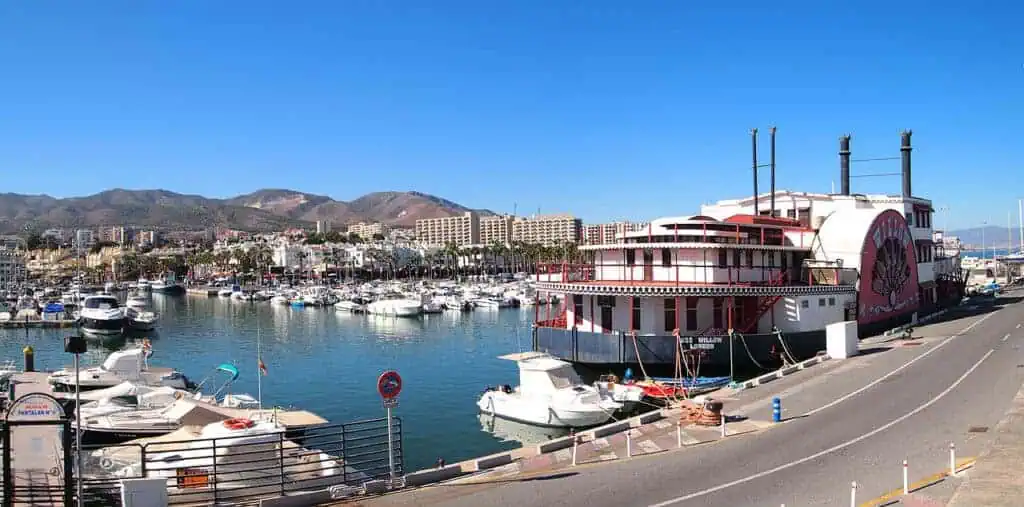
If we head south from Arroyo de la Miel towards the Mediterranean, we enter Benalmádena Costa. Here, the landscape transforms into a succession of first-class hotels, beach bars, palm trees, and miles of golden beaches. The absolute heart of this area, and the great nautical pride of all of us who live here, is its marina.

I’ve watched this port grow and transform since its beginnings in the 70s and 80s, and I can assure you there’s nothing else like it in the world. Its official name is Benalmádena Marina, but internationally it’s known as Puerto Marina. It has been awarded the title of “World’s Best Marina” on several occasions by specialized magazines, and you only need to take a stroll along its docks to understand why.
Its architectural design, the work of architect Eduardo Oria, is a magical and avant-garde blend of Arabic, Andalusian, and Indian styles, featuring a concept of floating residential islands connected by beautiful arched stone pedestrian bridges. The residential buildings have organic, cream-colored forms that seem to merge with the water and the masts of the luxurious yachts moored at its docks.
A stroll through Puerto Marina is a fantastic plan at any time of day. During the day, you can walk along admiring the boats, enjoy an ice cream, book a boat trip to see dolphins offshore, or rent a sailboat. At night, the port transforms completely, becoming the epicenter of the Costa del Sol’s nightlife, brimming with international restaurants, trendy cocktail bars, pubs with live music, and spectacular nightclubs where you can party until dawn. If you’d like to visit another aquatic animal park in the area, Selwo Marina is just a short distance away , an ideal option to round off your day at sea.
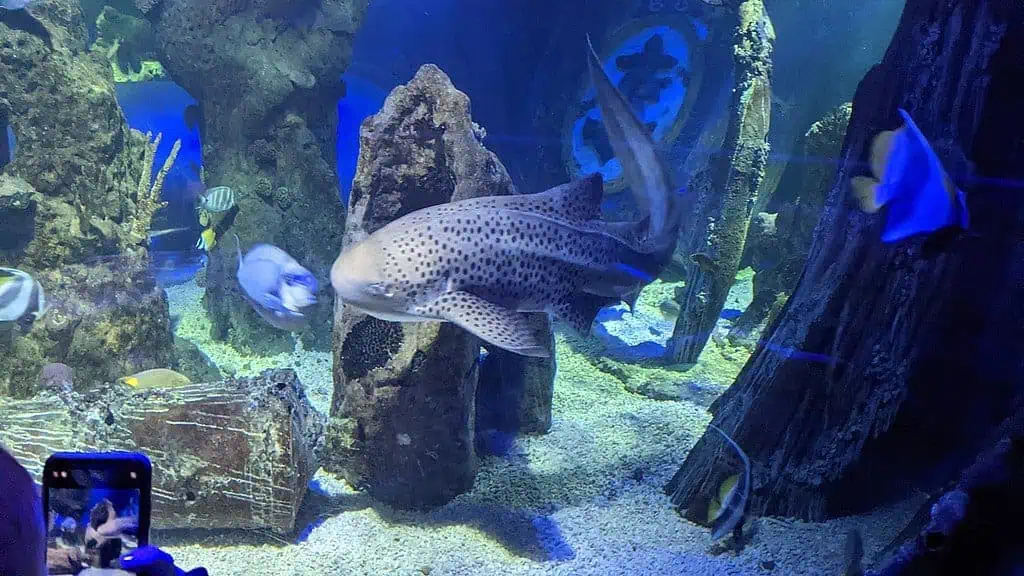
Located right at the main entrance to the Puerto Marina commercial docks is the Sea Life Benalmádena aquarium . It’s another fantastic interactive space, ideal if the day is a bit cloudy or if you want to surprise the family.
The main attraction at Sea Life is its spectacular 360-degree underwater glass tunnel. As you walk through it, you’re literally passing underwater while towering reef sharks, giant manta rays that seem to fly, and enormous rescued sea turtles swim peacefully just inches from your head. The aquarium also features wonderful interactive areas where children can get up close to exotic seahorses, intelligent octopuses, fluorescent jellyfish, and a colorful recreation of the coral reef teeming with clownfish (like Nemo). At the end of the tour, there’s a fun area with playful Asian otters and a themed mini-golf course overlooking the sea, perfect for ending your visit with some outdoor fun.
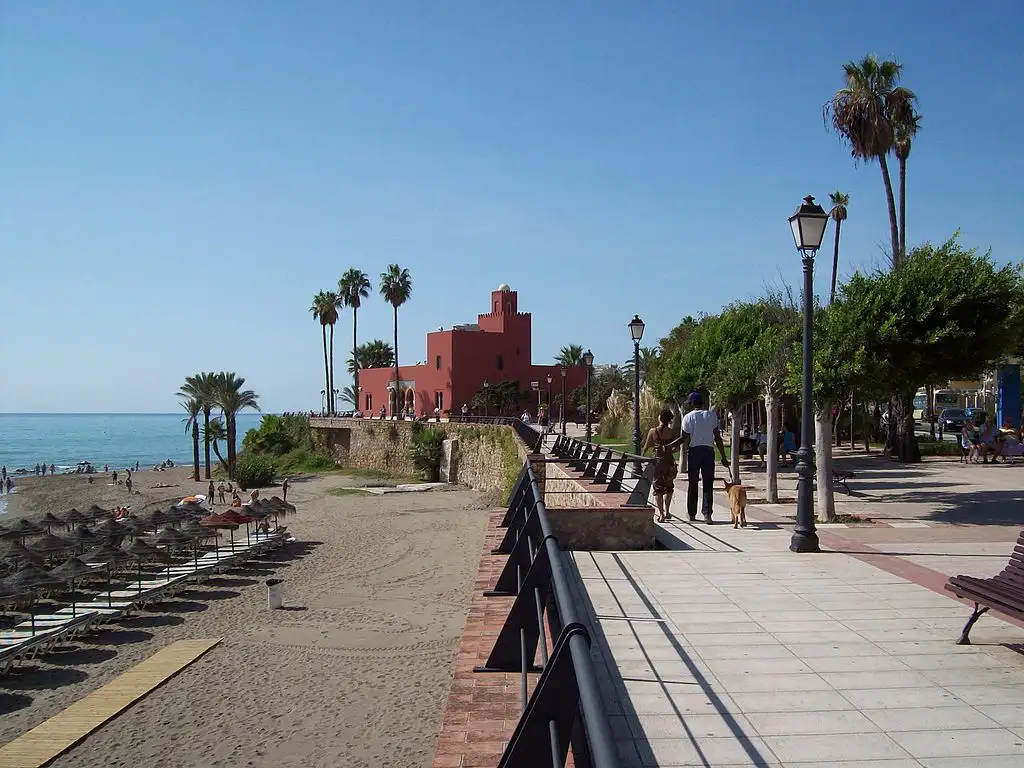
If you walk west along the kilometer-long seafront promenade from Puerto Marina, you will reach one of the most beloved, unique and photographed monuments on the Benalmádena coast: the Castle of El Bil Bil.
Despite its imposing appearance resembling a North African fortress or palace, it is not a medieval monument. It was built in the early 1930s as a luxurious private villa for a wealthy family (the Smetanovs, and later the Hermanns). Its exterior design is striking, featuring vibrant red facades, horseshoe-arched windows, decorative crenellations, and a beautiful Andalusian Mudéjar-style garden surrounded by fountains with water features and tall palm trees that face directly out to sea.
Today, the building is owned by the municipality and serves as a vibrant cultural center and contemporary art gallery. It also holds the unusual record of being the public venue for the most civil weddings in the entire province of Málaga, thanks to its unique and romantic coastal setting. Entry to the interior to see its tile-decorated courtyards and temporary exhibitions is usually free, although I recommend checking the opening hours beforehand as they change frequently between winter and summer.
Parking right next to El Bil Bil in the summer is nearly impossible, as spaces on the main avenue and the side residential streets are extremely popular. My trick is to park in the large underground public parking garage near Parque de la Paloma or next to the Santa Ana seafront promenade and take a pleasant stroll along the waterfront.
With nearly 10 kilometers of coastline, Benalmádena boasts a spectacular variety of beaches to suit every traveler’s needs and preferences. We have a total of 15 officially recognized beaches. Since I know perfectly well that not all beaches are created equal, I invite you to review my comprehensive analysis of the best beaches in Benalmádena so you can choose your perfect coastal spot based on the recommendations I detail below:
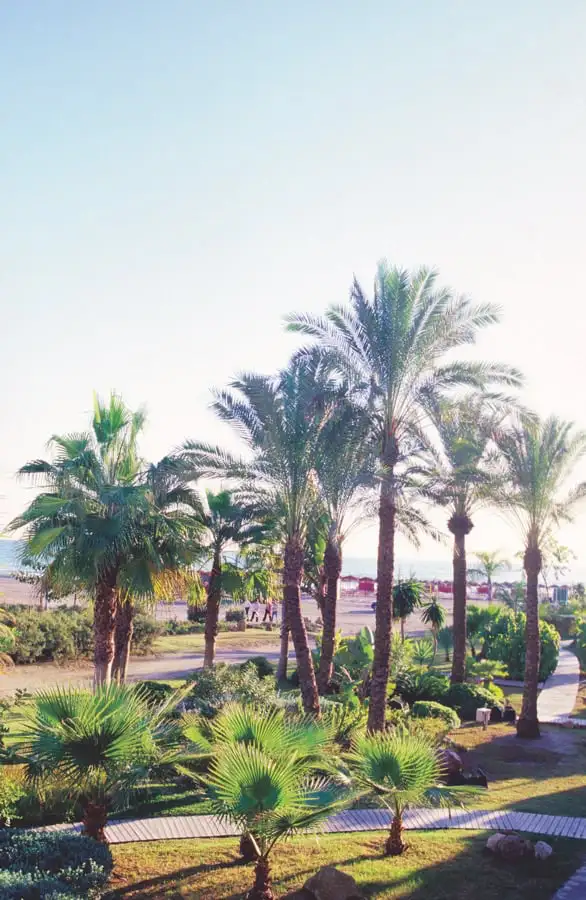
If you’re coming with children, looking for parasols, sun loungers for rent, showers, lifeguards, and a huge selection of beach bars just steps from your towel, these are the beaches for you:
If you’re like me and prefer to escape the crowds on the beach, looking for more rugged landscapes, rocky cliffs and crystal-clear waters perfect for putting on your snorkeling gear and seeing schools of fish among the rocks, you should drive to the western part of the municipality (towards Fuengirola):
Forty years of living here means you’ve eaten in many different places, I assure you. In Málaga, we love to savor our meals leisurely around a table with a sea view or on a cool village terrace. Benalmádena’s traditional cuisine is based primarily on Málaga’s rich seafood, combining the freshest fish from nearby fish markets with the bountiful vegetables and produce from the inland farmlands of the province.
When you sit down at a traditional beach bar or local tapas bar, you can’t leave without trying these local delicacies:
Here are my absolute safe havens, those places I take my own family to and where I know they’ll never let me down:

If you’re lucky enough to coordinate your holiday dates with our local festivities, you’ll discover the most authentic, joyful, and welcoming essence of Andalusian culture. In Benalmádena, we celebrate traditions with great passion, and the streets are completely transformed.
It is the main festival of Arroyo de la Miel and is always celebrated at the end of June, coinciding with the magical Night of San Juan (June 23-24). The fair usually lasts for about 5 or 6 days of non-stop festivities.
During the day, the festivities are concentrated in the town center of Arroyo de la Miel (the so-called “Day Fair”), where the streets are adorned with lanterns, locals and visitors dress in traditional flamenco dresses and short dresses, and Sevillanas are danced in the streets while sharing local wine, Cartojal sherry, and delicious portions of traditional tapas. At night, the activity moves to the fairgrounds (next to Parque de la Paloma), where dozens of amusement rides (“the little rides”) and public and private booths are set up, offering free concerts by top national artists, traditional dinners, and dancing until the early hours of the morning.
The Night of San Juan (June 23rd) has a special magic: at midnight, everyone heads to the beaches of Benalmádena Costa to witness the spectacular fireworks and the burning of the traditional Júas (satirical rag dolls). Following this sacred tradition, we dip our feet in the sea at midnight to attract good luck for the rest of the year.
It is celebrated in mid-August (around August 15th) in honor of the patron saint of Benalmádena Pueblo. It is a fair with a much more traditional, intimate, and typically local feel. The white squares of the town are filled with garlands, free communal meals of rice and gazpacho are organized for all attendees, and in the late afternoon and evening, the image of the Virgin is carried in procession through the steep and beautiful whitewashed streets of the historic center, in an atmosphere charged with emotion, devotion, and showers of flower petals from the balconies.
https://youtu.be/IqXNAMjdTbg?si=s-hvyZ0xUiolzmXu
Choosing where to set up your base of operations or base camp depends entirely on the type of vacation you’re looking for and whether you’ll have a vehicle to get around. After 40 years of watching the area’s hotels open and be renovated, here’s my honest assessment of the local accommodations:

Here are my personal recommendations, including names, of establishments with an impeccable track record in the municipality:

To wrap up this mega guide, let me put on my automotive industry professional hat and share my final practical tips as a local car rental owner. These recommendations will save you time, traffic fines, and a few unnecessary headaches during your vacation:
To be perfectly honest, if your holiday plan consists solely of leaving your hotel room in Benalmádena Costa, relaxing on a sun lounger on the beach across the way, having dinner at the beach bar next door, and enjoying a drink in Puerto Marina, you don’t need to rent a car. You can easily get around on foot along the seafront promenade or use a taxi or local bus for occasional trips.
However, if you’re a restless traveler who wants to make the most of your trip, things change completely. Renting a car gives you absolute freedom to:
Remember this: in summer (July and August) and during Easter week, the Benalmádena coastline is completely jammed with cars. Finding free street parking near the main beaches is like winning the lottery. So, take note of these tips:
Well, traveler, if you’ve read this far, you now have more information, tricks, and local tips than 99% of the tourists who visit us each year.
Benalmádena is a truly magical place. I’ve lived here for 40 years, and I can assure you that, even after four decades, I still enjoy watching the sunrise from the Puerto Marina docks, having an early coffee under the orange trees in Plaza de España in the town center, or watching the rabbits scamper across the grass in Parque de la Paloma at dusk, just as much as the first day. It’s a town with soul, one that welcomes visitors as if they were one of its own and offers everything you need for an unforgettable vacation.
Pack your bags, don’t forget the sunscreen, wear comfortable walking clothes, and get ready to enjoy one of the best gems of our beautiful Costa del Sol. And you know what they say: if you see a spotless rental car driving along our roads, driven by a traveler with a huge smile, it’s most likely someone who followed the advice in this guide. See you soon on the streets of Benalmádena! Have a great trip!